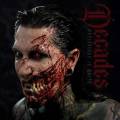
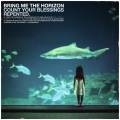
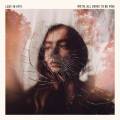
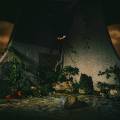
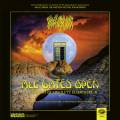
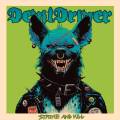
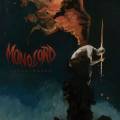
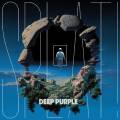
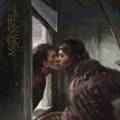
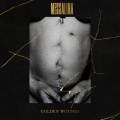
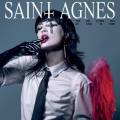
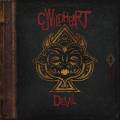
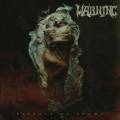
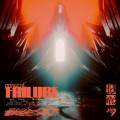
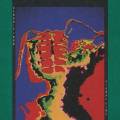
Seth Siro Anton is not only Septic Flesh’s bassist and vocalist – he also happens to be one of the most respected and fashionable visual artists of the time. As such, he’s behind the cover arts of many bands, including Nile, Ex Deo, Moonspell, Paradise Lost, Kamelot, and Exodus. The personality that shows through is art would be unmistakable among a thousand covers. It’s therefore no surprise that the man is so sought after, even if some don’t hesitate to accuse him of repeating himself. A criticism he understands but considers unjust: “Sometimes I use the same elements […] but it’s intentional”.
Even if he’s aware of the quality of his work, Seth is a naturally humble man, who doesn’t fear to voice his respect, sometimes even his admiration, for other artists, including the Duplantier brothers. He even goes as far as saying that Gojira are among his favorite bands, and that he would love to collaborate with them.
The frontman was getting ready to tread the boards at the Motocultor Festival (in France) when we met him. Although he was obviously tired, he showed much enthusiasm when we asked him to talk about his work as a visual artist, going as far as inviting us to his dressing room to discuss that subject and many others. A very spontaneous interview which ended up lasting longer that planned, and which, in Seth’s own words, turned out to be particularly interesting.
On the menu today: the state of the economy and of the music industry, art in general and, of course, his art in particular, since that remains the central theme of the interview. Although not much was said about Septic Flesh or the band’s music, at the end of this chat, he did share his feelings regarding their next album. According to him, it should be an important milestone for the band, and they should start composing it in the next few months.


Radio Metal: How are you doing?
Seth Siro Anton : Very good. Tired, but everything is perfect.
Let’s go to the point: Greece is currently going through a major economic crisis. What does that implicate for a band like Septic Flesh? Does this have a direct effect on you as a band?
I must say that maybe it’s the opposite. Even though you can see that we have some problems in Greece, I think that it’s not only a problem in Greece. It’s a problem that has to do with the world in general, with the US, and Europe. It started in the US and now we have the same problem with the Euro, in the European Union, from the south up. So it has nothing to do with Greece. Greece is just the first – let’s say “Guinea pig” for this experience. Even with this crisis, we don’t have any problems, because honestly I believe that art generally – if you look at the history of art – thrives during crisis or war or other things that aren’t so nice. Sometimes the crisis and the problems make art stronger.
There’s that, there’s the economic crisis in general, but there’s also the music industry that is not in a very good state…
No, listen. I hear many people say that about the music industry. I don’t think this is the case in reality. The music industry is suffering because the CD is not selling as good as it used to. But I like that, because even when the CD started to appear in the music industry, I never liked it, to be honest. Now we are in a “change mode”. The digital downloading is replacing the CD and maybe the sales will be even higher. If you want to see the positive feedback of music – and especially metal music – check the festivals everywhere. There are lots of people going there. And if you ask me personally, with Septic Flesh, our new album it’s one of the most selling albums that we ever made. All the limited editions that we made are sold-out, so I don’t see any crisis. In my opinion.
Yeah, it’s funny, it seems like you take all this in a kind of positive way, actually. Because many musicians we talked to are very pessimistic about things, whether it’s the state of the world or of the music industry, and you take it in a rather positive way. How do you keep being positive actually?
Actually, I am living from art, generally. I’m living from art, making artworks for bands, paintings, I do exhibitions, and I also have a band, Septic Flesh. Why shouldn’t I be positive? I mean, if the CDs are not selling like they used to, why should we say that the music industry as a whole is going down? One part of the music industry is going down because right now we have something new. It did the same thing from LP to CD in the past, if you remember. It was the same thing.

And do you think that as a band you are adapting well to that?
I gave you an example with our new album, The Great Mass. Season of Mist, our label from France, tell us that we have really good sells, our digipack is selling really well, our limited edition artbook is sold-out, the LP is sold-out. It’s only positive.
And about the artwork, there are a lot of bands now that are asking you to do the artwork for their album. How does that work when they do that? Do you come up with the concept or do they have some input?
To be honest, I prefer to always work with my own ideas and the concept that I have in my mind. Most of the times I prefer to work with my own stock, my own models. Only if it’s a well-known band which demands something specific. Like, for example, Kamelot or Paradise Lost, they wanted something really precise because they have their own style so they wanted to keep something from their roots. In situations like that, yes, I compile my own ideas with the band’s ideas. But in smaller bands, I think this is what they want: they want my style and my ideas on their album.
And where do you get the inspiration from? Do you listen to the music?
No, never. I prefer not to listen to anything; I use the art of surrealism. I prefer to use my true emotions, I prefer to use my soul as it is. Not to listen to something and then illustrate it.
That’s very interesting, because very often the artwork has a big impact on how someone listens to the music of the album. So if you don’t get your inspiration from the music, what do you think of the fact that the artwork influences the idea that the people get of the music?
You know what, I think that it’s something that [thinks]… Okay, on an album, you have something that you can see and something that you can listen to. You have two different forms of art, and this is the magic of art, here. Because you have two different expressions of art which each listener can decode in their own way, the artwork or the music. When you listen to Rammstein or when you listen to Gojira, you have different emotions than me, right? Each person has his own feelings and emotions. So I think that it’s something that has to do with the personality of each person that listens to the music or watches the artwork, you know?
But it’s interesting that if one of the albums that you did the artwork for had had a different artwork, people would have listened to the music differently.
Of course, for sure. The image always has a really strong impact on the final result. But again, I repeat that it’s something that everyone could decode differently.
You mentioned Gojira, which is a French band and our national pride. Since you brought them up, what do you think of them?
Exactly, it’s your national pride and to be honest, I’m also proud of this band because it’s a European band, and for me it’s one of the biggest modern bands in Europe. I have a lot of admiration for these two brothers, the drummer [Mario Duplantier] and the guitarist [Joe Duplantier], especially the drummer because I know that he’s also an artist.
It looks like you’re pretty proud to be European, from how you speak. You seem to be very attached to the roots of Europe.
Yes, I am proud and I really like this sweet melancholy and romanticism of European culture.
I know you did a featuring on a song by Lyr Drowning, a band from Paris. So since you like Gojira so much, since they’ve had a few guests on some of their songs, would you consider doing a featuring for them if they asked?
I would die [smiles]. For sure, of course I would. It’s one of my favorite bands, seriously, I admire them.

We’ll see if we can do something then [laughs]. Another question that I had about the artwork is that nowadays we see so many bands asking you for artwork, I’m sure you’re happy to have so much demand, but even though the strong personality in your art is a big strength, don’t you think it lacks in originality that every band is asking for you?
There’s something that sometimes makes me sad, I see comments saying “Seth is repeating himself”, “Seth is making the same covers”. I always respect people’s comments, even the negative ones, I respect everyone. But sometimes people aren’t judging very correctly. If I’m repeating or copying myself, it’s something that I like. I copy my own style and that’s why a band is asking me. Because they want my style. If I had something different on each artwork, it wouldn’t be me.
Well, actually, it’s not about the fact that you’re copying yourself. I don’t think you are copying yourself…
Sometimes I am, but I want to. Sometimes I use the same elements. I have a dreaming world, I have a distorted mirror of a unique soul. Everything comes from there. For example, the cover of The Great Mass and of Moonspell’s new album Alpha Noir and Omega White, I used some of the background – not the same, it maybe has the same mood, but it was on purpose.
I think the criticism is more about the fact that these artworks all have the same atmosphere, which is your personality. There was the same criticism a while ago when all the metal artworks were done by Travis Smith.
Exactly, Travis Smith had the same problem because he was making all the cover artworks for one period and people said “Travis is repeating himself”, of course. But Travis Smith is amazing. I want to be clear about this though, the mentor, the first one who started all this artwork illustration was Dave McKean. Travis Smith, me and Niklas Sundin from Dark Tranquility, and all these new designers have really big influences from McKean. Really big influences.
There’s another one who’s gaining success right now, the guitar player from Baroness, John Baizley. There are a lot of artworks from him as well.
Oh yes, he has his own style. He’s from the US isn’t he?
Yeah.
There’s also another designer from France, Valnoir. He made the new Paradise Lost.
Anyway, about the fact that people are criticizing you or Travis Smith for repeating yourselves, don’t you think the criticism should be towards the bands for all asking the same artists rather than the artists themselves?
Why criticize? If a band chose this designer it means that they wanted to express their own feelings and music from that visual result, so why criticize? You don’t pay for this to criticize it, you pay for this to enjoy it. Yes, you can criticize some things, but you don’t take it to ask “why this?” and “why that?”.
I think only metal bands ask you to do artwork, don’t they?
Not only.
Really? I don’t know, my question was going to be: would you like to do other things than metal bands?
Of course, in Greece I did artwork for some famous bands which don’t have anything to do with metal music. But generally, I prefer to make artwork on dark music. For example, I don’t like power metal. It’s not my style and I would never make an epic cover. Even though I like Amon Amarth and we’re really good friends now, I respect them a lot, it would be really difficult for me to make a cover artwork for Amon Amarth.
So if Manowar asked you, you wouldn’t do it? [laughs]
No, no [laughs]. Even though I respect Manowar, I can’t. I would betray my… I’m a dark artist, you know.
That’s another question, because yes, your artwork is pretty dark. Where does this darkness come from? Why do you always want to express something so dark? Especially since you’re so optimistic in real life.
Exactly, this is something that would need a bigger conversation. First of all, I studied fine arts, which is really important. Actually, making artworks and being a digital designer wasn’t my first occupation. I studied painting, analog painting, photography and stage design. Then I did some digital process and DTP (desktop publishing). What I want to say is that it was really important for me to have this classical education first. As you can see from my work, it’s more towards fine art than towards illustration. Then, about the darkness, why an old woman and an old guy with a dog, why be darker and not have a nice blond woman with silicon everywhere, like a frog, you know, plastic surgery and everything? For the average person, this blondie is prettier because she has nice lips, a nice face, nice boobs and everything. So this is what they like, and the old couple is disgusting. For me, it’s the opposite. Do you understand? Darkness has to do with how you decode what’s dark and what makes you feel happy. I’m a dark artist because that’s how people see it, for me I’m not a dark artist, I’m an artist. I express my emotions through art, nothing else.
Greece has a strong art history. Are you influenced by it?
Yes, I’m very influenced by Greece, but mostly from Egyptian and Sumerian art. I have a lot of respect for these civilizations. But of course, my work is totally mixed, now. You can’t see exactly the Greek influences.
And Egyptian and Sumerian art also influences you in your music.
Of course.

Last question, do you have any news about what Septic Flesh is going to do in the near future?
This year, in October, we’re going to the US for a one month tour. It’s going to be the first time we’ll play in Mexico and Costa Rica, we’re really happy. After this tour, we’ll start to compose the new album. This album is going to be really important for Septic Flesh. It’s really difficult for us to do something better than The Great Mass.
Because you think you’ve reached…
Yes. I will not say the typical stuff that our next album will be the best album and better than the others. I don’t know what we’re going to do. Art is not like a public service: « Okay, I’ll make a new nice song! » it’s a matter of inspiration. So for us it will be a great challenge to make something better than The Great Mass. We did that with Communion. For me, we made a really good album.
Maybe the best thing to do would be to do something really different.
Exactly, that’s also in our minds.
Do you already have any ideas?
It will be even darker, for sure.
Even darker? Communion was pretty dark.
Now we’ll go even darker.
So the artwork will be a black cover? [laughs]
[Laughs] For the artwork, I have to be honest, it will be really minimal this time. Because the cover of The Great Mass took me four months. It was really complicated, all these statutes and stuff, it was a lot of work.
Interview conducted by Spaceman and Stan on August, 17th, 2012 at Motocultor Festival, France.
Transcription: Stan
Seth Siro Anton’s official website: SethSiroAnton.com.
Septic Flesh’s official website: www.septicflesh.com.